
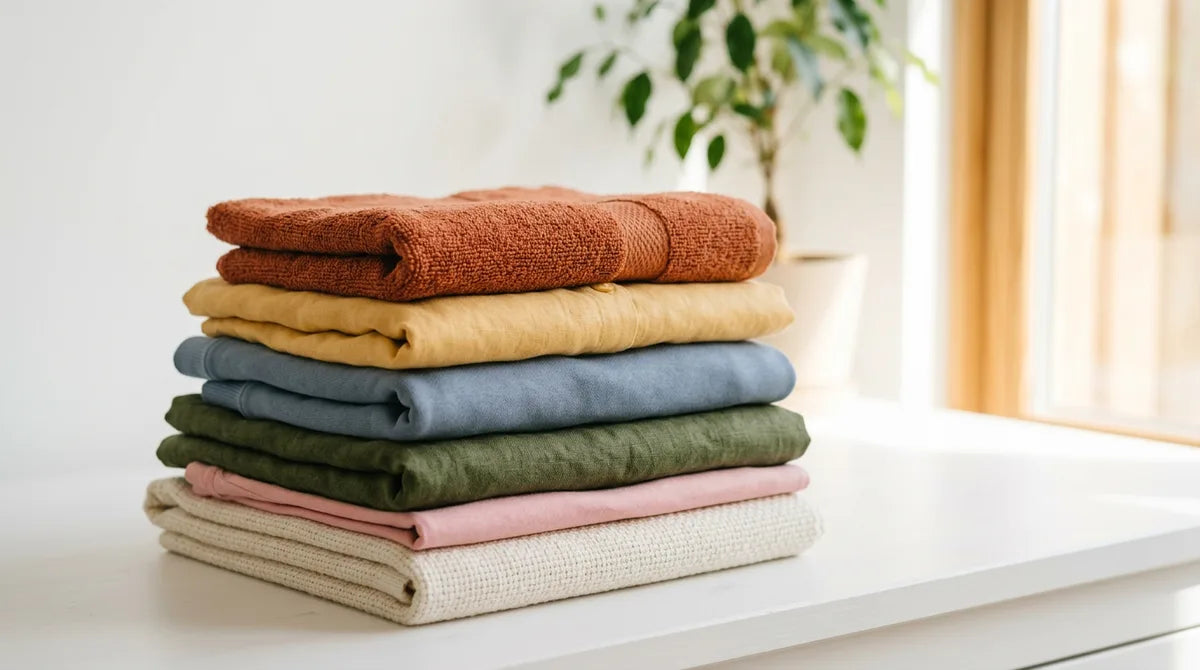
When washing laundry by fabric, read the garment's care label first. The name cotton, polyester or wool does not on its own determine the washing temperature. Two garments made from the same fibre may differ in dye, coating, stitching and trims. When choosing a programme, consider the wash action, stain treatment and drying alongside the temperature.
In what order should we read the information on a care label?
Do not think of the label as merely a temperature symbol you glance at before loading the machine. Washing, bleaching, drying, ironing and professional care information describe different operations. One stage being permitted does not mean the others are suitable too. Make that distinction particularly on a garment you have just bought or are treating for a stain for the first time.
| Information | How to read it |
|---|---|
| Washing temperature | The number is the maximum temperature that must not be exceeded. |
| Bars under the wash symbol | One or two bars indicate the need for a gentler treatment. |
| Bleaching information | Checked before choosing a stain or whitening product. |
| Drying information | Separately shows whether machine or natural drying is suitable. |
| Professional care information | Helps you judge the care method required in place of washing at home. |
A 40°C limit, for example, does not mean the garment must be washed at 40°C every time. When choosing a lower temperature, also consider the level of soiling and the detergent instructions. In the same way, do not try to meet a delicate-programme symbol simply by lowering the temperature; read your machine's description of the relevant programme.
Choosing a programme and care routine by fabric
Everyday cottons and blends
Do not put T-shirts, shirts, bed linen and towels in one group simply because they are cotton. If colour, care instructions and level of soiling suit the same programme, consider washing them together. For a T-shirt with a print or trim, the care information for the piece as a whole matters as much as the fabric percentage.
Synthetics and technical textiles
For a sports top, a lined garment or a piece combining different fibres, read the specific notes the manufacturer gives. The programme name, any restriction on softener and the drying information are useful at the point of purchase too. Photographing the label is a practical way of being able to check wording that fades over time in later washes.
Woollens
For woollen garments, establish from the label whether machine washing, hand washing or professional care is the option. Woolmark recommends choosing a mild detergent suitable for wool. Do not assume every woollen piece is suitable for washing at home. Your machine having a wool programme does not cancel out the garment's own care restrictions.
Silk and other delicates
Check first whether wet treatment is suitable. A small-area test is a preliminary check; it does not change care instructions that forbid washing. Rather than trying one product after another on a valuable piece whose fabric or dye you are unsure about, consult its manufacturer or a professional cleaner.
Choose the product for the job you want to do
Herbaclean Laundry Detergent is offered for the general washing of white and coloured laundry. In the machine, the amount varies between 50 and 95 ml according to capacity, water and soiling. On delicate fabrics, check the product's suitability separately. Choose the dose from the table according to your own washing conditions.
If Washing Power is being considered for an additional stain treatment on white textiles, the fabric limits are clear: it is not used on coloureds, wool, silk or leather. For the soaking option, one scoop of product is dissolved in four litres of water; the water must be at most 40°C and the soaking time at most six hours. If the garment has a lower limit, keep to that as well. After soaking, wash in the machine or rinse thoroughly with clean water.
Fabric Softener is a separate product aimed at a preference for softness and a soft scent. Set the dose according to its own packaging and check the textile's care note regarding softener. Do not use a single common measure for detergent, stain product and softener.
A quick check before starting the programme
- Match the care requirements of the pieces you will wash together.
- If there is a stain, complete the pre-treatment according to the product and fabric instructions.
- Check the load limit of the chosen programme in the machine manual.
- Measure the detergent and follow the correct usage section.
- When the wash is finished, move on to the garment's drying instructions.
Frequently asked questions
Can all whites be washed at a high temperature?
No. Being white is information about colour; the temperature and treatment limits are still read from the garment's label.
Is the same spin speed suitable for every delicate garment?
Do not apply a single spin speed to all garments. Follow the care label together with the chosen machine programme's explanations of load and spin.
Can Washing Power be used on a white wool jumper?
No. The product's restriction on wool is independent of whether the garment is white.
If the label has faded, can I decide by the name of the fabric?
First request the product's care information from the garment manufacturer. On pieces with coatings, linings and trims in particular, the fibre percentage alone may be incomplete information.