
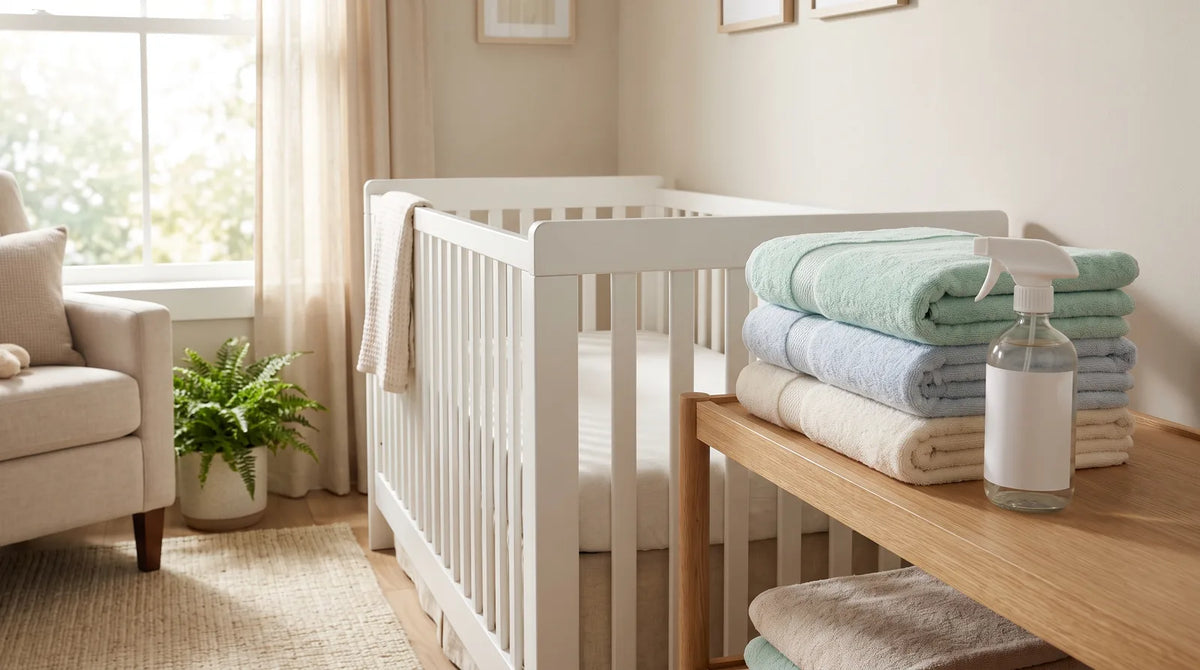
Before you start cleaning in a home with a baby, keep the child away from the area you are working in, store products out of their reach and follow the care instructions for every surface. Caring for a toy that goes into a child's mouth is not the same operation as treating a floor. Building the daily routine on that difference makes it clearer both how to divide the work up and which product belongs at which point.
First job: organise the cleaning cupboard
Keep cleaning materials in their own labelled packaging, with the caps closed, in a locked cupboard children cannot reach. It becomes hard to tell what a liquid is once it has been decanted into a drinks bottle or a food container. Even where packaging has a child lock, do not leave the product out. These storage principles apply to every cleaning product, whatever its scent or marketing name.
When you organise the cupboard, do not look only at the large detergent bottles. The small spray in a bag, the open tub of wipes in the bathroom and the single-use pack left on top of the machine belong to the same system. Show everyone who shares the cleaning at home where the products are kept, and remind them to close the caps after use.
Four things to prepare before you start cleaning
- Separate the space. Move the baby to a suitable area under another adult's supervision. Do not carry on cleaning while holding the baby, or leave an open bucket beside them.
- Clear things away. Collect the toys and textiles from the floor. Take items such as food bowls, bottles and dummies out of the area you are working in.
- Choose the product. Read the label for the surfaces it is for, the dilution ratio and whether rinsing is required. Check the surface's own care instructions too.
- Make the job smaller. Complete one area rather than wetting the whole house at once. If you are interrupted by the phone or the door, put the products and equipment away first.
Treat floors, toys and the high chair separately
| Item or area | Starting point | Check when the job is done |
|---|---|---|
| Washable hard floor | A product suited to the floor covering, and a measured dilution | Application complete, floor dry, bucket put away |
| Play mat | The mat manufacturer's material and cleaning instructions | No moisture or product build-up left between the layers |
| Toys that go in the mouth | A method suited to the toy's age and material instructions | Required rinsing and drying completed |
| High chair | Separate care instructions for the tray, harness and cushion | Steps relating to food contact completed |
For example, Herbaclean Surface Cleaner is used on suitable washable hard surfaces by adding 100 ml to 5 litres of water. Apply the prepared mixture with a cloth or mop compatible with the floor. This usage information is not an instruction for a toy, a dummy, a bottle or skin cleansing. Nor does a product not requiring rinsing on a surface make it suitable for every baby item.
Tie daily jobs to the moment of use
You can treat spills after feeding, the pieces left on the floor after play and the dirt that gathers by the front door as separate small jobs. Rather than cleaning every room again at the end of the day, look at which areas were actually used. A living room where guests were received and a room that was not used that day may not call for the same amount of work.
Separating cloths by the area they are used in also makes the job easier: the cloth you use for the high chair should not be the same as the bathroom cloth. Fold a dirty cloth and carry on with a clean face; change it when no clean face is left. When the job is done, clean and dry the cloths according to their own care instructions. Do not leave a used cloth next to the toys or on the feeding tray.
Do not guess the dose for baby laundry
For clothes, bedding and washable toys, the wash symbols determine the programme. Set the amount of detergent by the load, the level of soiling and the product's dosage table; do not automatically use half a dose simply because the items belong to a baby. In the same way, giving every piece a single common temperature is not appropriate. Prints, padding and different fabrics may call for different care.
When planning laundry care, read the usage information on the Herbaclean Laundry Detergent page together with the garment's label. Put washed items away only once they are completely dry. If you need to avoid a particular ingredient, request the current ingredient information from the manufacturer; do not make your choice based on the scent or on a plant image on the packaging.
Frequently asked questions
When can the baby come back into the room that was cleaned?
Complete the product's ventilation and re-use instructions; check that the surface is dry and that all materials have been put away. There is no single number of minutes that applies to every product and every room. The scent fading is not on its own a criterion.
Can I wipe my baby's hands with a surface cleaning wipe?
Surface cleaning products are not personal care wipes. For your baby's hands and skin, choose products and methods intended for that purpose.
Is it all right to wash all the toys in the same bucket?
No. Batteries, fabric stuffing, paint and different surfaces change the method. First separate the toys according to their care instructions; do not include parts that should not be immersed in water.
Does the word "herbal" mean a product is suitable for babies?
No such conclusion can be drawn from that alone. Decide on the basis of the product's intended use, its current label and the required warnings. The rules on storage and keeping products away from children do not change.