
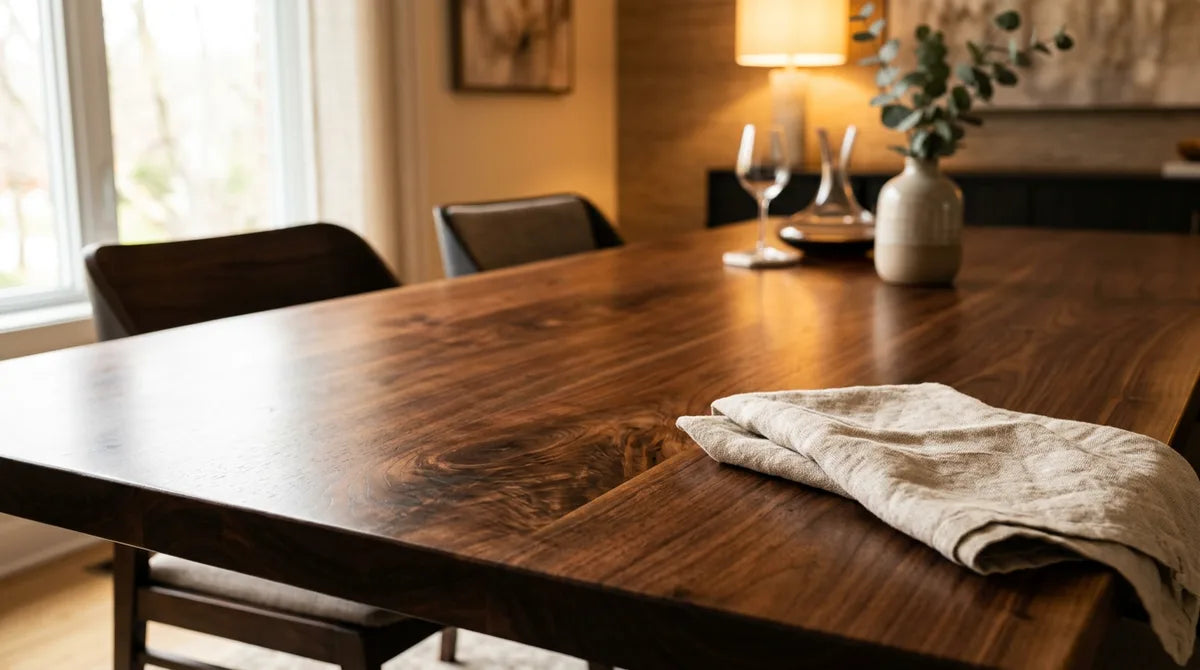
When cleaning wooden furniture and wood floors, first establish the surface's finish and its care instructions. Remove the dry dirt, prepare the right product at the right ratio and apply it without leaving excess water. A wood cleaner is used to remove dirt; it does not take the place of renewing a lacquer, repairing scratches or applying a care oil.
The finish matters as much as the type of wood
Two oak tables may call for different care when the varnish, oil or paint on them differs. "Solid", "veneer" and "laminate" likewise do not describe the same surface structure. Check the purchase documentation for the furniture or the manufacturer's care page. Do not automatically treat a surface you cannot identify by sight as washable.
| State of the surface | Starting decision | Special care |
|---|---|---|
| Finished wood with care instructions | Dry cleaning by the stated method and, if needed, a suitable product | The amount of moisture the finish allows |
| Raw or unlacquered wood | Following the manufacturer's instructions for raw surfaces | Not including it in a general wet-wiping routine |
| Oiled or waxed surface | Obtaining care information suited to that surface treatment | Treating cleaning and renewing the finish as separate matters |
| Surface with lifting, opening or cracking | Limiting cleaning and assessing the damage | Preventing liquid from reaching the joints |
Remove dry dirt before cleaning
Lift things off the furniture rather than dragging them. Take up loose dust with a clean, soft cloth; check that no hard particles are caught in it. On wood floors, use a brush head or dry dusting equipment suited to the surface. Cleaning corners and around the legs first reduces the need to come back to the same spot during the damp stage.
When the cloth gets dirty, turn to a clean face. Do not press hard on the surface with a seam or a fold. Rather than dragging a small crumb along the whole table, lift it off first. If dry dusting is enough, you do not have to wet the surface again simply because it is in the weekly schedule.
How to prepare Herbaclean Wood Cleaner
Herbaclean Wood Cleaner comes in a 1000 ml pack and is used by adding 100 ml to 5 litres of water. It is lavender scented. Rather than pouring the product straight from the bottle onto the furniture, prepare it at this ratio first. Use a container of known volume to measure; do not turn an unmarked bottle cap into an eyeballed measure.
- Check compatibility. Read the care instructions for the furniture or floor. On first use, test on a small hidden section and assess how it looks once dry.
- Prepare the mixture. Add 100 ml of product to 5 litres of water. Do not mix in another cleaner, vinegar or care oil.
- Set the dampness of the cloth. Dampen a suitable cloth or mop with the prepared mixture and wring out the excess water. Wipe in small sections without pouring water onto the surface.
- Check any remaining moisture. Do not leave pooling at edges and joints. The product does not require rinsing; if there is excess moisture, take it up with a clean, dry cloth.
This method is intended for wooden furniture, doors, suitable wood floors and wooden cabinet surfaces. On surfaces whose finish is unknown, that are unsuitable for water or that are damaged, consult the manufacturer first. A product being for wood does not make every type of wood and every surface treatment suitable for the same application.
Different details matter for furniture and floors
On a table, the base of a glass, the underside of a vase and the joints along the edges call for more attention. Check these areas are dry before putting things back. On a cabinet door, do not let liquid gather around the handle and hinge fixings. A veneer lifting at the edge is not a cleaning mark; it may need care or repair.
On wood floors, do not leave water at doorways, board joints and along skirting boards. A very wet mop and steam cleaning are not appropriate methods for the care of wood floors. Do a quick check after each section to see any pooling that may have formed. Using equipment suited to the floor's surface comes before pouring on more product.
What to do about water rings and scratches
Lift spilt liquid without leaving it to sit. You can reduce everyday contact by using coasters and suitable protectors. When a white ring, a scratch or a dull patch remains, do not increase the amount of cleaner; work out whether the problem is in the finish or in dirt on the surface. Sanding, oiling and lacquering are separate operations; do not carry them out without learning what the existing surface treatment is.
If the furniture looks clean but its sheen has changed, examine it dry first. Some surfaces are matt by design; making them glossy does not have to be a cleaning goal. On old or valuable furniture with a permanent mark, consult the manufacturer or an appropriate furniture care specialist rather than trying experimental recipes.
Frequently asked questions
Can I apply wood cleaner directly to the surface?
The usage ratio for Herbaclean Wood Cleaner is 100 ml to 5 litres of water. Dilute it first, then wipe with controlled dampness.
If no rinsing is needed, is drying unnecessary too?
No. Excess water must not be left on wood. Take up any visible pooling with a clean, dry cloth.
Does the same method apply to raw wood?
Do not automatically include raw wood in this routine. Follow the manufacturer's care instructions specific to that surface.
Does the product remove scratches or renew a lacquer?
A cleaning product does not take the place of those repairs. Treat scratches and lacquer as a separate care matter suited to the surface's finish.